Sunday, November 11, 2007

Are you defensive in your relationships?


Who Me? How to Deal with Defensive People James Tamm Santa Clara University School of Law


A coworker responds with anger whenever someone disagrees with him. A husband retreats into silence whenever he gets into an argument with his wife. An employee buries her boss in piles of irrelevant information whenever she is asked a question.


These behaviors might appear different, but they're all just variations of the same problem -- defensiveness. Additional forms of defensive behavior include habitually claiming, "I already knew that," when corrected... rationalizing or explaining away every misstep... or chronically making fun of others to deflect criticism from oneself.
Defensive people believe that their reactions protect them from outside attack. In fact, defensive people are unconsciously trying to shield themselves from their own doubts about their significance, competence or likeability.
We all get defensive sometimes and to some degree, but most of us learn to limit our defensive tendencies. Those who don't curb their defensiveness make life difficult for themselves and those who live and work with them. Their chronically defensive behavior promotes conflict and divisiveness... encourages rigid thinking that stifles creativity... and brings out the defensiveness in others.

Here's how to control your defensiveness -- and better deal with the defensiveness of those around you...

DEALING WITH DEFENSIVE PEOPLE
The best way to blunt other people's defensiveness is to not become defensive yourself, even when provoked (more on that later). If you start to get upset, remind yourself that this person's defensiveness is rooted in his/her insecurities and has little to do with you. Arguing back will only make the person more insecure. Instead...
Be a good listener. After the emotional moment has passed, offer the defensive person a chance to speak with you about the situation that led to the defensiveness. During the conversation, resist the urge to evaluate, criticize or suggest. Just listen intently, and take both the words and emotional content into account. Every now and then, summarize what you're hearing to make sure you understand -- and to make sure the person knows that you're really listening.
Example: A coworker is upset with you because you criticized his proposal in a meeting. Rather than defend your position, listen to what your coworker has to say, then summarize -- "You felt I misunderstood your recommendations" or "You were embarrassed in front of your colleagues."

By listening, you help the defensive person feel understood and accepted, easing his insecurities and making future defensive reactions less likely.
Change the way you argue. Try "interest-based negotiation." With this strategy, your first goal is to state your opponent's underlying interests to his satisfaction. Your second goal is for him to do the same to you. Only then do you start proposing solutions. This creates an atmosphere of understanding that makes defensiveness less likely.
Example: I once mediated a labor strike in which the union insisted on a 7% raise, though the union leaders knew that management couldn't go past 4%. The discussions became adversarial. Through interest-based negotiation, management learned that the underlying goal of the union negotiators was not the 7% raise itself, but to make good on a promise they had made to their members to deliver a 7% raise. The parties agreed to a 7% raise for six months of the year, the equivalent of a 3.5% annual raise, which was within management's budget. Union members were happy with the 3.5% increase overall and pleased to have the negotiations resolved.

MANAGING YOUR OWN DEFENSIVENESS
The most difficult step in overcoming defensiveness in yourself is acknowledging that you are indeed defensive. You probably consider your responses to perceived criticisms to be rational and justified when they occur. Reconsider them after the moment of confrontation has passed. Do they still seem appropriate, or were they unwarranted and unhelpful? If you're not certain, ask your spouse or a trusted friend -- and try not to get defensive at the reply. If you feel you tend to be defensive, identify the form your defensiveness takes. Are you belligerent? Uncommunicative? Overly talkative?

Other warning signs of defensiveness: Tightening in the gut... general sense of paranoia... adrenaline rush... feeling that you lack allies... a sense that you have been personally rejected, though the subject under discussion is only tangentially related to you.

To cut off defensive reactions...
Intercept the physical symptoms of defensiveness, such as rapid, shallow breathing and a quickened pulse. It will be easier to alter your behavior if you can alter these physical reactions. Head to the restroom and splash cool water on your face... take a short walk to calm down... or if there's no time for a break, take a few long, deep breaths.
Monitor your thoughts. If your mind is telling you, "This guy is out to get me," or "She doesn't think I'm very smart," you're likely to become increasingly defensive. Respond to negative thoughts with positive self-talk.
Examples: "I know this is difficult, but I can get through it"... "They're entitled to a different opinion"... "If I listen carefully enough, maybe I can learn something."
Develop a reaction appropriate to your particular form of defensiveness. If you tend to flood others with information when you feel attacked, force yourself to remain quiet for a full minute. If you tend to shut down, push yourself to say something. If you counterattack when you feel confronted, take a few deep breaths and find something that you can agree with in what's being said.
There are times when we must defend ourselves against verbal attacks, but these times are rare -- and knee-jerk defensiveness isn't effective anyway. Defensive reactions make us feel temporarily better about ourselves but rarely paint us or our opinions in a favorable light. Defensiveness provides no defense -- it only makes us seem less credible.

Flue tips -how to avoid the bug

How to Flu-Proof Your Home... Car... Office Susan Rehm, MD
National Foundation for Infectious Diseases

In the past year, we have repeatedly heard about the threat of an avian flu pandemic, but most people don't think about the reality here and now of the "regular" flu. Each year, tens of millions of Americans contract influenza. For most, it just makes for an unpleasant week, but 200,000 flu sufferers each year end up in the hospital -- and 36,000 Americans die from flu complications. Most outbreaks occur between October and May, with the peak season between late December and early March. To flu-proof your home, car and office...

GENERAL STRATEGIES

Get the vaccine. You know this already, but it bears repeating because as many as two-thirds of those who should get the flu shot, don't -- even though it is the single best way to flu-proof your life. The Centers for Disease Control and Prevention recommends flu shots, particularly for anyone over age 50, because potentially fatal flu complications are more common as you get older. Flu shots also are strongly recommended for children from six months to five years... and for anyone with a chronic lung, kidney or heart condition, diabetes or a weakened immune system.

Wash hands properly and often. Hand washings must be vigorous and last at least 20 seconds to be effective. Simply lathering up and quickly rinsing aren't enough. It's the act of physically scrubbing one hand against the other with soap that dislodges flu viruses.

If you're not near a sink, an alcohol-based hand sanitizer can be equally effective. Just don't apply so much of the sanitizer that your hands remain moist for very long. Hands become sterile only when the alcohol evaporates, leaving them dry.

Learn the difference between a cold and the flu. People often mistake bad colds for the flu. The onset of the flu is sudden, and includes fever, severe muscle aches and fatigue, while colds tend to take hold gradually and often are not accompanied by severe aches or a fever. When flu includes a cough, it tends to be a dry cough.

Important: The reason it is crucial to know the difference between the cold and the flu is that a prescription antiviral, such as Tamiflu or Relenza, can help reduce the severity of the flu -- but only if taken within 48 hours of initial infection. Call your doctor immediately if you think you have the flu.

HOME

Kids, grandkids and your spouse are the ones most likely to bring the flu virus into your home. What to do...

Avoid sharing silverware, glasses and kisses with a family member who is not feeling well.

Use disinfectant wipes to clean items you commonly touch, such as doorknobs, drawer handles, kitchen appliances, phones and remote controls.

Ask your doctor for a prophylactic dose of an antiviral medication, such as Tamiflu or Relenza, if someone in your house has the flu. These prescription drugs can reduce the odds that you will come down with it.

Postpone visits from young children if they are not feeling well or if the flu has been active at their school. When a visit from young children is unavoidable, wash your hands thoroughly after touching the children or objects they have recently handled. After the kids leave, use disinfectant wipes to clean items they touched.

CAR

When you share a car ride with someone, you also share the air in a small, enclosed space. If one of you has the flu at the beginning of even a short trip, the odds are good that both of you will by the end. What to do...

Encourage sick car pool members to stay home. If you find out that you shared a car in the past 48 hours with someone who has the flu, ask your doctor for Tamiflu or Relenza.

If you let someone else drive your car -- even a parking attendant -- use alcohol disinfectant wipes on the door handle, window controls, steering wheel, gearshift handle, parking brake lever, seat controls, radio controls and any other surfaces that the other driver is likely to have touched. Do this even if the person didn't seem sick.

WORKPLACE

The biggest threat is sick colleagues who drag themselves to work.

Don't share office supplies. Shared pens are particularly dangerous because many people unthinkingly touch them to their lips. Always carry a pen with you (which also is useful for signing at stores and restaurants). Avoid sharing your phone and computer keyboard. When office equipment must be shared, wash your hands thoroughly before and after use and wipe off the equipment with a disinfectant wipe.

Other office trouble spots: Door handles, drawer pulls, conference room tabletops, water fountains and elevator, fax and copier buttons.

Keep an eye out for coworkers who sneeze into their hands. These people spread their germs when they handle office equipment or shake hands. Sneeze into a tissue, shoulder or sleeve.

If you attend a meeting featuring snacks and handshakes, try to handle your food only with your left hand to decrease the odds that flu germs will make it to your mouth. When in the office cafeteria, don't touch your change and then your food without washing your hands in between.

Use a paper towel to turn off the water and open the door after washing your hand in the office bathroom.

Encourage sick colleagues to go home -- and do so yourself if you are not feeling well. If you are a manager, make sure employees understand that a sick day won't be held against them.

Saturday, November 10, 2007

Ten ways to keep your relationship hot


Ten ways to add romance to your marriage By: Nancy J. Wasson

It's all too easy to take your marriage for granted, especially if you've been married for a long time. Here are some ways to rekindle romance in your relationship.

Every marriage needs a healthy dose of on-going romance to add spice, delight, and fun to the relationship. It's not enough to just start out with a sizzling romance. You have to find a way to keep the romance alive as the months and years accumulate.
One of the marital challenges many couples face is how to live together without losing that special romantic spark. It's all-too-easy to lose the role of lover along the way. When this happens, spouses often start relating to each other as they would to a friend or a sibling. Parents can begin to feel they are only “business partners” joined together to raise their children and keep the household running.


How can you keep romance alive when your daily work schedule is grueling, you're always short on time and energy, and you're not sure what to do? Here are ten tips to help you sprinkle romance into your marriage:
1. Pay attention when your spouse mentions things he or she likes or expresses interest in something that could make a good gift, such as a new CD, a book, or theater/concert/sports tickets. Be on the lookout for ideas for birthday, holiday, and anniversary gifts, plus “no reason” surprise gifts. It's very flattering to know that someone really tried to find a gift that was just what you wanted.

2. Frequently offer foot massages, shoulder massages, and full-body massages to your spouse. You'll get plenty of romantic brownie points in your “relationship bank account” if you keep some great-smelling lotion handy and take ten minutes to massage your spouse's tired feet at the end of a long work day. Note: If you expect to be rewarded for your efforts by sex, you won't accumulate any points for being romantic. Your spouse will just think you have an ulterior motive when you offer a massage in the future.


3. Giving sweet cards and letters to your spouse can be romantic, as can emails and phone messages that share your feelings and passion. Handwritten letters sent through the mail are becoming more and more of a rarity. That's good for you because that means your spouse will think you're really romantic for taking the time to write a love letter by hand and mail it. That will make more of an impact than just sending an email if you want to get extra brownie points.


4. Another way to be romantic is to look for opportunities to pamper and spoil your spouse. That might be letting a spouse sleep in late while you watch the kids, or it could be telling your partner to sit down and relax while you clean up after dinner. The key is in the delivery of the offer. You might say, “Nothing's too good for my sweetheart” or “You're such a love. It's fun to pamper you.” You can accompany your words with a hug or kiss.


5. Talking in front of your spouse to someone else about your partner's good points is romantic. Take full advantage of opportunities to say, ‘I'm so lucky to have such a supportive wife (or husband)—she's such a treasure. I'm a lucky man.” You can also do this when you're talking on the phone and know that your spouse is within listening range. If you're not sure your partner heard you, when you get off the phone ask, “Did you hear me telling my sister what a great husband you are? I was really bragging on you!”


6. In the romance department, flowers, plants, candy, or a special home-cooked meal never go out of favor. Many females love to receive beautiful fresh flowers or a box of delicious chocolate candy. Both husbands and wives can appreciate the efforts of a partner to put together an intimate, special home-cooked meal by candlelight with music playing and flowers on the table.


7. Surprise your spouse with a framed picture of the two of you in a setting that will bring back pleasant memories. Another option is to frame a picture of your spouse that shows him or her in a flattering way and let your partner know how much you love the photo. Keep it on your nightstand, computer, dresser, or desk and let your spouse see you looking at it admiringly.


8. Take the initiative to plan a surprise weekend outing. Call and make all the arrangements ahead of time. The outing doesn't have to be expensive or complex. It might be as simple as planning a picnic at a nearby scenic spot. You might prepare the surprise picnic lunch when your spouse is in the shower. Or you might make arrangements for a restaurant to pack a gourmet lunch for the two of you that you could pick up on your way out of town.


9. Music that you and your spouse both like can set a romantic tone. If you see a movie that you both enjoyed a lot, you might consider buying the sound track as a surprise gift the following week. You could also select a song that you both like and decide to make it “your song.” Or you could pick a song and tell your spouse that it reminds you of him or her for some positive reason.


10. Celebrate every occasion you can think of—the anniversary of the day you met, when you became engaged, your marriage anniversary, your birthdays, seeing the full moon, and anything else you can come up with. You can toast with champagne (or non-alcoholic champagne) and perhaps have a celebration meal. But it can be just as fun to make a big deal out of going out for an ice cream cone to celebrate.

Saturday, November 03, 2007

Your Health: Arguing with Your Spouse Could be Hazardous to Your Health Rallie McAllister, M.D., M.P.H.

Here's one more reason to strive for marital bliss: Arguing with your spouse could be hazardous to your health. Researchers at the University College London recently announced their findings that individuals who experienced high levels of negativity in their close personal relationships -- especially marriage -- were 1.34 times more likely to experience chest pain, heart attacks and even sudden cardiac death. The study, which involved more than 9,000 British civil servants, appeared in the October 2007 issue of Archives of Internal Medicine. Noting that negative marital interactions are often associated with depression and anger, the researchers concluded that these emotional reactions contribute to cardiovascular disease by exerting a cumulative "wear and tear" effect on various organs, including the heart. Even in the absence of marital discord, individuals who harbor negative emotions, including hostility and anger, could be putting their health in danger. A recent study conducted by researchers at Duke University

Medical Center found that men who frequently experience intense feelings of hostility, anger and depression are at greater risk for developing high blood pressure, coronary artery disease and type 2 diabetes. Previous research suggests that individuals with hostile personalities and those who are highly anger-prone are nearly three times more likely to suffer heart attacks than their more mellow counterparts. The link between anger and heart disease appears to hold true even after adjusting for other major cardiovascular risk factors, including high blood pressure, high cholesterol levels, cigarette smoking, and obesity. Doctors and scientists have long suspected that people with short fuses have shorter life expectancies, but the reasons for this association are not entirely clear. It could be that angry individuals are more likely to engage in hazardous behaviors, including smoking cigarettes and drinking excessive quantities of alcohol, which in turn contribute to heart disease. Or it could be that hotheaded individuals tend to have higher levels of stress hormones, which can constrict the arteries around the heart and elevate blood pressure. Stress hormones also appear to interfere with the proper function of immune system, leaving individuals with hostile, angry personalities more vulnerable to cardiovascular disease and other illnesses. Anger and hostility aren't the only emotions that can affect heart health. In the February 2007 issue of Archives of General Psychiatry, researchers at Indiana University announced their findings that depression may lead to the initiation or progression of atherosclerosis. Also known as hardening of the arteries, atherosclerosis is a major contributor to heart disease. In a study of over 300 men and women, the scientists analyzed individuals' depressive symptoms and measured changes in the thickness of their arterial walls. At the end of a three-year period, the researchers noted that the men and women with the most severe depressive symptoms demonstrated the greatest increases in thickness of their blood vessel walls, a finding consistent with the development or progression of hardening of the arteries.

Based on these observations, the researchers concluded that depression might play an important role in the early stages of coronary artery disease. According to researchers at Duke University Medical Center, frequent bouts of depression, anxiety, hostility or anger can significantly increase the risk for developing cardiovascular disease, but having a combination of these traits is a far more powerful predictor of future heart problems. A similar pattern is known to exist with physiological cardiovascular risk factors, including high blood pressure, high cholesterol level, and obesity. While having any one of these conditions increases the likelihood of developing heart disease, having all three conditions is especially dangerous.

Although negative emotions can be damaging to your health and your close relationships, positive emotions can have the opposite effect. The simple act of laughing can alleviate stress, lower blood pressure and boost the disease-fighting properties of the immune system. Scientists at the University of Maryland Medical Center found that people with healthy hearts tended to use laughter as a means of alleviating emotional stress. Folks with ailing hearts, on the other hand, were 40 percent less likely to laugh in a number of humorous situations. Even if you can't manage to laugh about the situation, it might be a good idea to talk about it, especially if you're a woman.

One study found that women who regularly suppressed their anger had higher death rates than those who aired their feelings. Whether you're trying to improve the health of your heart or the health of your marriage, spending time laughing and talking with your spouse is a great place to start.

Tuesday, October 30, 2007

Finding Happiness After Major Life Crisis

People in the midst of divorce, job loss or a health crisis are often led to believe their lives will be richer, deeper, even happier for the experience -- but new research says it isn't necessarily so. A recent study challenges aspects of the classic "happiness set-point" theory which points to in-born personality factors as being the primary determinant of happiness. Under set-point theory even major changes in life circumstances do not have a long-term effect. However, says lead researcher Richard Lucas, PhD, a psychology assistant professor at Michigan State University, traumatic life events such as divorce, job loss or disability from, say, major illness matter deeply and may shift your happiness set-point permanently south. Dr. Lucas shared what he learned about happiness and offered advice on what you can do to stay positive in the face of difficulties.

IF YOU'RE HAPPY AND YOU KNOW IT...

According to the happiness set-point theory, challenges and crises can temporarily move people away from their set point, but their basic outlook and coping skills will eventually settle back at their original level. While Dr. Lucas agrees that personality traits play a strong role in happiness, his research shows that long-term levels of happiness can and often do change after experiencing a major life event -- not necessarily returning to where they were before.
To take a closer look at the nature of happiness, Dr. Lucas examined two large-scale studies in Great Britain (more than 27,000 participants) and Germany (nearly 40,000 participants). Participants in Germany were followed for up to 21 years, and participants in Great Britain for up to 14 years. Using self-reporting scales, researchers measured their levels of satisfaction before and after major events such as marriage, divorce, job loss, widowhood and disability. People seemed to adapt fairly quickly to marriage and even widowhood, though that took longer. However, their emotional state was more often permanently altered by divorce, unemployment or the onset of a long-term disability, according to Dr. Lucas.
Specifically, researchers found that...
  • Most people adapt to marriage within a few years. However (no surprise here) there is a great deal of variability, with some getting a long-term boost and others a long-term decline, depending on how good the marriage is.

  • On average, people take about seven years to adjust to the loss of a spouse.

  • Following divorce, unemployment or physical debilitation from a major illness or injury, people generally do not return to their prior level of happiness.

FACING REALITY IS WHAT HELPS

While Dr. Lucas's research may sound defeatist, it is helpful to consider it a learning tool rather than a reason to give up. For those who have experienced a traumatic event, Dr. Lucas says it's a good idea to set "challenging but realistic goals" to bolster your sense of accomplishment and esteem. Also helpful is having -- and seeking -- good social relationships, as studies have shown the physical and emotional health benefits of a strong support group.
In the long run, though, what may help most of all is taking the pressure off yourself for not feeling entirely happy with your new situation, realizing that such events are very traumatic and they do, in fact, change your world. Understanding that the success and happiness you find may look and feel very different than what you've experienced in the past is one key to finding your "new" way to feeling good.
Also remember that challenges present an opportunity for growth and personal development -- but avoiding the subsequent soul searching and not questioning personal assumptions can and usually will leave you worse off. If you are able to become more honest with yourself and others, and allow yourself to benefit from the awakening that challenge may bring, then adversity may indeed present an unexpected blessing and evidence of grace -- and these are certainly seeds from which happiness can grow.

Source(s):

Richard Lucas, PhD, assistant professor of psychology, Michigan State University, East Lansing, Michigan.


R U Ready for Windows Live Messenger Beta 8.5? Try it today!

housework bad for your health

...and another thing
For anyone who doesn't warm to the demands of housework, here's a headline that might look like a Get Out of Jail Free card: "Housework Could Pose Health Hazards."

You can hear it now: "Mom, I can't clean the bathroom every week – it's hazardous to my health, according to the Centre for Research in Environmental Epidemiology in Barcelona." And it's true. The Spanish team spent nine years collecting asthma data from 10 European countries. More than 3,500 subjects were followed.

Results showed that the risk of developing asthma was as much as 50 percent higher for people who cleaned at least once each week using cleaning sprays, glass-cleaners, furniture-cleaners, and air fresheners. The study didn't reveal the biological mechanism that prompted the spike in asthma risk, but there's no doubt that toxic elements (such as chlorine) in cleaning products can produce harsh health effects – and you can be sure that asthma is only one of the problems. So how can you protect yourself and keep your home clean? For several years I've used a number of Seventh Generation cleaning products that go easy on the environment. And I don't think it's too much of a leap to assume they also go easier on the person who swings the mops and scrub brushes. I don't have any data to back up that claim, but given the choice between green and chlorine…

You can find more information at www.seventhgen.com.

Monday, October 08, 2007

men women -weight tips

Weight Watchers’ SecretsWhat works for women... What works for menKaren Miller-Kovach, RD Weight Watchers International, Inc.Published: September 1, 2007 he fundamental requirement for weight loss -- expending more calories than are taken in -- is the same for men and women. But there are clear differences in the ways in which men and women approach weight loss, including whether they even believe that they need to lose weight.
Couples who understand the male/female differences can work together to achieve their weight-loss goals. Main differences -- and strategies for helping each other...
She’s Aware, He’s Not
Woman’s view: Our society values thin women. As a result, women are always conscious of their weight -- and they are quicker to diet, whether or not they really need to lose weight.
Man’s view: The average man spends little time in front of a mirror and is unlikely to notice that he’s gained a few pounds. Our society values large, strong men, so men often excuse their weight. They’ll say something like, “I’m just a big guy.”
Strategies: Both men and women find it difficult to be objective about their own bodies. To provide some objectivity -- whichever your sex -- you should know your body mass index (BMI), a well-accepted standard for determining a healthy weight. A BMI of 20 to 25 is optimal... 25 to 30 is overweight... and over 30 is considered obese.
You can compute your BMI by dividing your weight multiplied by 703 by your height in inches, squared. Easier: Use the BMI calculator at www.weightwatchers.com.
Also important: Know the circumference of your waist. Even if you have a normal BMI, you could have a high proportion of belly fat -- which is a risk factor for diabetes, heart disease and other health problems. Risks accumulate when a woman’s waist circumference exceeds 35 inches... and a man’s exceeds 40 inches.
Men often think that their pants size is also their waist size -- but most men wear their pants below the belly.
To accurately measure waist circumference, place a tape measure at the top of the hip bone and measure evenly around the bare abdomen. The tape should be snug but not pushed into the skin.
For Beauty, For Health
Woman’s view: Women tend to use appearance-related words and phrases (“I’d like to look thinner”) when talking about their weight.
Man’s view: Many young men also worry about appearance, but most men over age 40 are more concerned about the health aspects of weight (“I don’t want to have a heart attack”... “I want to have more energy”).
Strategies: A man can encourage a woman’s weight-loss efforts by giving her unsolicited compliments, such as, “You look great in that dress.”
Because men respond best to fitness words, such as fit, healthy or in better shape, their partners can encourage them by linking weight loss to health improvements -- “You’ll have more stamina when you play with the kids” or “This will keep your blood pressure down.”
Depressed Eating, Happy Eating
Both men and women engage in emotional eating -- eating for reasons other than hunger -- but the emotional triggers often are different.
Woman’s view: Women tend to consume excess calories when they’re feeling negative emotions, such as stress or depression.
Man’s view: Men tend to overeat when they’re feeling positive emotions -- for example, when they’re enjoying themselves at parties, happy hours and ballgames.
Strategies: Partners can help each other by recognizing their different emotional triggers. If a woman has had a bad day at work, her partner might gently head her off at the refrigerator and suggest that they go for a walk to talk about it.
A man might ask his partner to warn him if he is hovering near the party buffet table or the bar.
Less Food, More Exercise
Woman’s view: Women who are trying to lose weight usually focus more on cutting calories and less on exercise.
Man’s view: Men focus more on exercise to lose weight, rather than on eating less.
Strategies: For the greatest chance of success, both men and women have to combine exercise and calorie restriction. To drop one pound in a week, you have to eliminate 500 calories each day. Very few people can exercise enough to burn that much -- and just cutting calories can take the weight off but doesn’t support keeping it off.
You have to do both. Trim calories, and get 45 to 60 minutes a day of moderate-intensity exercise -- such as brisk walking, swimming or playing golf without riding in a cart.
Little Changes, Big Changes
Women tend to view weight loss as a long-term war. There are times they attack... times they retreat... and times they have a negotiated settlement. Men tend to view weight loss as an all-or-nothing battle.
Woman’s view: Women tend to make small changes that they hope will lead to long-term weight loss, such as substituting low-calorie mayo for regular or having one piece of chocolate instead of two.
Man’s view: Men are less patient. They do better when they make big changes -- giving up beer or desserts completely, for example.
Strategies: The male approach is more effective, research suggests. It’s difficult for most people to maintain their commitment to portion control. If they keep eating the same foods, the portion sizes tend to gradually increase. It’s often better to give up something than to have “just a little.”
Friends, Experts
Woman’s view: A woman trying to lose weight will solicit advice from friends and share successes and setbacks. She wants the support of her peers and to know all of her options.
Man’s view: Men are less likely to talk to friends about weight loss. They don’t want too many options. What they want is expert -- and specific -- advice.
Strategies: For men, women are often the weight-loss experts. A woman can help a man lose weight by limiting his options, for example, by stocking the fridge with fruits and vegetables. She can point out to him at a restaurant that the grilled fish is a better option than the fried-fish platter.
This approach generally doesn’t work with women. A woman who asks her partner what to have for lunch may well get annoyed if he tells her specifically what to have. In reality, she would rather discuss the possibilities on the menu before making a decision. So if she asks you what to eat, you could say, “There are several good possibilities here. What do you think would be best?”

Sunday, June 10, 2007

Better Relationship tips

useful tips for people who are open minded enough to try or listen QJ

Strategies for a Better Marriage
Robert Stephan Cohen, Esq.

Cohen Lans LLP n my 30 years as a matrimonial lawyer, I have listened to countless men and women tell me why their marriages failed. Disagreements over money and lifestyle, and, of course, infidelity, lead all kinds of couples to divorce court. Divorce is so common nowadays -- expected, even -- that couples start thinking about it at the first sign of trouble.

I have seen enough divorce battles up close to have a good handle on the marital mistakes couples make. Many issues can be worked out -- if there's a real desire on both sides. Here are the most common problems that endanger marriages and strategies to deal with them...
Parallel lives. A couple might live in the same house and share the same bed, but their communication may be perfunctory. They could go for days without really talking.
Both spouses are so busy with their "own" lives that they more or less forget they're married. Whether because of busy careers, child rearing or even time-consuming hobbies, they never make time for each other.

Strategy: Carve out time for each other by picking one night a week to go on a "date." That means time together -- no phone calls or kids. Also, don't let a day go by without having a conversation, even if it is by phone.

I recall one professional couple who had little free time for each other. They decided to share part of every day by walking their dog together. This simple change helped get their marriage back on track.

Infidelity. Cheating spouses who want to save their marriages need to stop cheating and -- assuming that they haven't been discovered -- keep their mouths shut.
Strategy: That's right -- don't tell. Telling a spouse about a one-night stand or an affair that has ended may make you feel less burdened and more virtuous, but you'll have created an enormous obstacle that the marriage may never overcome. Marriages fail not because of an affair, but because of the aftermath.
Warning: If the cat is out of the bag, don't try to fix things alone. Couples who successfully get past a known affair almost always do so with the help of a neutral party, such as a member of the clergy or a therapist.

Sexual incompatibility. Most people who have been married for a while have sex less frequently than they once did. Some people are fine with that. For others, a lack of sex colors their view of the entire marriage.

How powerful is the sexual aspect of a marriage? In three decades, I have never had anyone come into my office wanting a divorce even though sex at home was great.
Strategy: Couples must discuss their sexual needs and wants. The increasing popularity of sexual topics in mainstream media may make it easier to broach the subject. One spouse could refer the other to a relevant article, for example, or they could go to a therapist together.
Problem children. I have seen a number of marriages collapse over differences in how to deal with troublesome children. In the cases I have dealt with, the children were heavy drug users or had serious mental illness, but even minor problems with children can damage a marital relationship.

If spouses already are leading parallel lives, they begin to line up in separate camps with their children. For instance, one spouse might hide a child's misconduct from the other. Then when the misconduct becomes impossible to ignore, the parents take opposite positions. In my experience, mothers frequently think that love and affection will alter their children's behavior, while fathers are more likely to take a tough stance. The fierce arguments that follow can destroy a marriage.

Stepparents have a particularly tough time. The children often try to undermine the new marriage because they see it as a threat to their own relationships with their parents and they still hope that their parents will get back together.
Strategy: Enlist the help of a neutral authoritative third party. When doctors or therapists take over much of the decision making in terms of the child's treatment, the husband and wife can address marital issues and comfort each other, which often brings them closer together.

Money matters. Financial disagreements can cause serious trouble for any couple, no matter how well-off they are. Historically, wives often have been in the dark about a couple's finances -- and this is true even today.
Whether the husband insists on handling the money alone or the wife is willfully ignorant, the result often is heated arguments about finances that spiral into personal attacks on each other's values, common sense and honesty. It undermines a marriage when, for instance, one spouse simply tells the other that the couple can't afford a trip this year.
Strategy: For the best chance of marital success, both spouses should be familiar with the household's finances and have a say in spending and investing. Then the couple's expectations will be similar and, in many cases, more realistic.

Some people think a prenuptial agreement is unromantic, but I'm a big fan of them -- and the lessons I've learned through using prenups can be applied at any time during a marriage.I recommend that engaged, newlywed or even long-married couples talk to an accountant, financial planner or even a divorce lawyer to get a sense of how the economics of the marriage can work. Then they should keep talking about money so that things stay out in the open at home.

Tuesday, May 15, 2007

Stop victimizing yourself

The Hidden Victim in All of Us

Ever been in the presence of a person who likes to play "victim"? It's painful, right? Some so-called victims are easy to spot. "Woe is me" is their mantra as they mope around, whining about what life has done to them, and being devoted to their sad state. But, there is a whole other category of people who act in ways that are far more subtle and difficult to recognize, says life coach Lauren Zander, of The Handel Group Private Coaching (www.handelgrouppc.com). The problem is that the undercurrent of complaint and misery that is generated by these "undercover" victims creates stress and exhaustion not only for them but for those who are around them, too.
Taking on a false sense of victimhood has become pervasive, adds Lauren, which is destructive to society. Some people play that role daily. But, mentally, almost all of us fall into the trap of feeling like a victim at least now and then. How to overcome victimhood and be powerful instead? I discussed this with Lauren...
WHAT IS VICTIMHOOD?
At the root of victimhood is an internal power struggle in which the victim sees what he/she perceives as problems in the world around him (this includes his personal world of family and work or even the global environment) yet believes he is helpless to change things.
The sure sign of being a victim is complaining. Victims do it a lot and their constant chatter is about what's wrong with other people. "The innocent is telling his story," Lauren says. "Everyone else is the problem -- the reason it isn't working -- the 'only ifs' are always focused on others and victims believe they are just reporting the crimes of their boss, mother, husband, kids, the school system and the world and how these people and institutions have all wrongly impacted them." This focus on other people makes it hard for victims to look at their own behavior to see it for what it is -- their complaints. Consequently, they adamantly deny they are acting as a victim.
On the flip side, victimhood also provides a subtle reward to the complainer. As victims observe others' failings and how hurtful they are, they set themselves up as martyrs secure in the knowledge that, although they are the wounded party, they are right -- and the feeling of being right is very powerful. "Victims feel heroic for putting up with the bad behavior of people around them and being the good guy in the story," says Lauren. Acting as a victim also places people outside the situation -- peering in and observing the "poor behavior" of others. By declaring themselves to be outside observers, victims assign power to others. Victims may sigh that they are helpless to change a situation -- be it a dominating spouse, a difficult job, a community they dislike, etc. -- but in truth this belief allows them to squirm out of action to change the situation. They blame their spouse or boss or whoever is in the wrong... and then become a martyr, perceiving that they can't change the situation. This, in turn, spares victims the pain of giving up the goodies, be it, for example, the comfort of marriage (even if it's painful), the security of a pay check (even if they hate the job) or the relief of not moving.
The sad reality is that victims are so busy shining their haloes and feeling superior to the "wrong-doers" that few victims are really interested in changing their behavior. But victimhood, whether occasional or chronic, is a passive way of coping. Victims waste energy on complaining instead of putting the energy into action where it can serve a useful purpose. Complaining is an attempt to be dominating because the victims do not help or do anything to change the situation, they simply watch and comment about it, says Lauren. But ultimately this is fruitless because human happiness is connected to productivity and to making a difference. "To have the ability to fix things that aren't working for us, to solve our own problems, this is what feels good," she says. Fortunately, there is a path that leads out of victimhood.

GETTING PAST VICTIMHOOD

Step One: Listen to your complaints. Victims' sighs and complaints cover up a basic feeling -- fear. This is what often lies under the behavior. Complaints often center on something or someone that truly does make victims unhappy, but they are too frightened to take action, even by just speaking up. Instead, they hide behind their whining words. And so the first step away from being a victim is to listen carefully to the content of your complaints and look for recurring themes and what you avoid saying or doing.

Step Two: Locate the fear behind the complaints. The easy rationale for complaining is that it is merely reporting, just observing how it is. But life is not the weather and chronic complaints have an emotional basis. That is where you will discover the fear. Let's say you are upset about the "ridiculous" rules your company has for its employees or perhaps the way your spouse is behaving, and you regularly regale your friends about how put upon you are because of them. The logical action is to quit talking about it and speak up and/or move on. But "action always involves risk because there is no way to predict its consequences," says Lauren, and giving up a job or a marriage is scary territory with lots of risk.
However, if you go to the heart of the matter and identify your fear, you empower yourself to make a choice. You know how you feel and what you fear, and now you are in a position to decide what you want to do with this. Will you take the risk of discussing your feelings with your boss or spouse or even deciding to walk away? Will the pain of change be greater or less than the pain of staying in the situation? While action in the form of communication and/or physical change is the most productive path, you may choose to stay in the current situation, realizing that the pain of change would be too great. By choosing not to change you are acting on real feelings, which makes you no longer a victim in the situation. "Making a decision from a place of honesty -- whatever the decision -- is a big step forward because it negates the victims' belief that they have no choice in the matter," says Lauren. "They see that they have the power to choose to either stay in a situation or leave it."
What about more global issues beyond your personal life such as governmental decisions, the education system or the potential for a bird flu pandemic? Here, too, you have several powerful options. You can choose to get involved in the macro issues by working for or volunteering for an organization that relates to the issue at hand. Or, you can start a program of your own that addresses the issue (that's how programs like Mothers Against Drunk Driving and the Special Olympics were started). Or, you can choose to do nothing and allow the "powers that be" to handle the situation. As long as you consciously choose to accept the status quo, then you are shedding the role of victim. But, this also means that you shed the role of complaining when you hear or watch the actions being taken.

Step Three: Give up complaining. This is probably one of the most incessant traits of victimhood. This occurs not only on an individual basis, but has become pervasive in the media and among politicians, which makes those who watch the news "victims of their victimhood." Refusing to complain is a major shift but extremely freeing because it shuts the valve to the emotional release found in victimhood. Instead of voicing a complaint, look inward to determine why this bothers you -- and what you can do about it. "The actions called for are generally simple and obvious," says Lauren, "but starting anything is a brave act." Instead of whining that you have no friends, make a plan about how to meet new people. Rather than moan that your job is taking you nowhere, decide what you want to do and start the process of educating yourself for it. The first step you take toward a more productive, victim-free life will lead to the next step... and the next... until one day sooner than you may think, you are there.

Tuesday, February 20, 2007

Q-jumpers

Q-jumpers: "A smile is good medicine
A smile is good for your soul and laughter is very good medicine 6

Quick facts about us :
The e-mail address for inquires on 'Back to Eden' wellness communities is. Backtoeden@dependmail.com. The Ridgetown location address is 23 Richard Street. Phone 519-674-3434

“New Beginnings” is a Care facility that is over 8000 square feet in size, fully client appointed with a qualified staff and a strong reputation as a quality service provider in the Chatham/Kent region. Our present resident mix is 10 with the potential for a further 8. We market our care facilities under the 'Back to Eden' umbrella brand name. The location name is 'New Beginnings.'

Humor New words in your work space or place contributed by S.Holle
1. BLAMESTORMING
Sitting around in a group, discussing why a deadline was missed or a project failed, and who was responsible.

2.SEAGULL MANAGER: A manager, who flies in, makes a lot of noise, craps on everything, and then leaves.

3.ASSMOSIS: The process by which some people seem to absorb success and advancement by kissing up to the boss rather than working hard

4.SALMON DAY: The experience of spending an entire day swimming upstream only to get screwed and die in the end.

5. CUBE FARM : An office filled with cubicles.

6.PRAIRIE DOGGING : When someone yells or drops something loudly in a cube farm, and people's heads pop up over the walls to see what's going on.

7. MOUSE POTATO : The on-line, wired generation's answer to the couch potato.

8.SITCOMs: Single Income, Two Children, Oppressive Mortgage. What Yuppies get into when they have children and one of them stops working to stay home with the kids.

9.STRESS PUPPY: A person who seems to thrive on being stressed out a"

Tuesday, February 13, 2007

Advisor.ca - Growing your business

Advisor.ca - Growing your business: "Earn client confidence: an eight-point checklist
Jeff Thorsteinson


(February 2007) 'If you have confidence in your lure, you will catch fish,' says one of the millionaires interviewed by Thomas J. Stanley in his book The Millionaire Mind.
There's wisdom for advisors in those words. When it comes right down to it, confidence is the key to success in this business. Everything you do as an advisor, whether selecting investments, building financial plans, or creating a customized client service process, is all intended to earn the confidence of your ideal client. That confidence in hand, you can build the practice you want — with the clients you want.
I realize there are a number of coaches out there who tout a reality that just doesn't jive with this, but it is certainly within your reality to corral a group and instill confidence about your ability to achieve for them. "

Wednesday, January 31, 2007

You are what you eat Men stand up and pay attention

Kitchen "Cure" for Erectile Dysfunction Many men look to the little blue pill to solve the problem of erectile dysfunction (ED), but according to a recent Italian study from the second University of Naples, the real answer might not be in the medicine chest but in the kitchen. The study investigated how following a Mediterranean-style diet (a diet rich in whole grains, fresh fruits/vegetables, dried beans and other legumes, olive oil, nuts and fish and a reduced intake of red or processed meat) would impact ED in men with metabolic syndrome, defined by a cluster of symptoms, including raised blood pressure, abdominal obesity, insulin resistance, blood lipid disorders and elevated markers for blood clotting and inflammation. Men with metabolic syndrome also have a higher incidence of ED -- nearly 27% versus 13% of men without the syndrome. For this study, researchers gathered 65 men with both ED and metabolic syndrome and put 35 of them on a Mediterranean diet. The 30 men in the control group received information about healthy eating practices, but they did not follow a specific food plan.

At the end of two years, approximately one-third of the men on the Mediterranean diet regained normal sexual functioning versus just two men in the control group. And more good news -- those following the Mediterranean diet had a significant decrease in blood glucose, insulin, LDL cholesterol, triglycerides and blood pressure and a significant increase in HDL cholesterol. Furthermore, their blood showed lowered inflammation and improved endothelial function (having to do with blood vessel function). Study authors speculate that the increased fiber and antioxidants in the diet, with its emphasis on whole foods and olive oil, may play a role in the men's improvement, though all elements acting together may have been even more important. I spoke with urologist and ED specialist Arthur L. Burnett II, MD, professor of urology and director of the Male Consultation Clinic at the Johns Hopkins Medical Institutions about this study. He says that this may be the first controlled study demonstrating how effective dietary changes can be. While he agrees that because ED and cardiovascular disease have been shown to have some of the same risk factors, the increase in antioxidants in the diet would surely have had an impact.

He also points out that when people are eating healthful foods, they are eating fewer injurious ones such as high-fat meats. Dr. Burnett adds that we need more research to further confirm whether diet and modified lifestyle can limit or reverse the problem of ED, but it is obviously intuitive that eating healthfully as well as maintaining a normal weight and cholesterol levels and not smoking are, at the very least, important steps.

Monday, January 29, 2007

How to always win

Interesting with some good points

How to Always Win
A stellar characteristic of Americans has always been their ability to compete, indeed to win. This zeal to achieve has accomplished many wonderful things for our country and its citizens, including major medical discoveries, unparalleled economic success, even liberty itself. But after the extremely negative campaigning of the recent elections, and the endless nightly debate about whether or not we are winning the war on terror and who's to blame for what's right or wrong in our country, I can't help but ask if our need to compete has gone awry. It doesn't seem to be enough any more to succeed. What worries me is people's need to take it a step further to prove they are right, and sometimes, to prove they're right no matter what. You can be sure that a win-at-all-costs attitude does not contribute to good relationships on a global scale or, as concerns me here, to personal relationships, which are, after all, the bedrock of a person's emotional and physical well being.
For insight on this painful problem, I talked with Lauren Zander and Meredith Haberfeld of Handel Group Private Coaching (www.handelgrouppc.com). Lauren points out that in every conversation, people have an agenda. It might be to inform, to amuse, to get to know each other better or just to pass the time -- there are lots of reasons for verbal exchanges. But when the agenda includes ensuring that you are right, by definition it means establishing that the other person is wrong. There isn't a conversation in the world that doesn't ultimately come to a screeching halt if one or both parties have the attitude that "I am right, you are wrong, now get used to it." This is incredibly destructive to any relationship -- in the Middle East, in the workplace, with your in-laws, or in the bedroom -- because it slams the door on any real possibility for a dialog. In fact, Lauren says the battle to be "right" is at the base of all dysfunction, be it wars between countries, conflicts at work or closer to home -- marital or parent-child conflicts.
WHAT IS FACT?
There is a simple truth at play here. It is possible to be right -- look out the window and if you see water falling from the clouds you can rightly announce it is raining... or that the sun is shining... or that it is night or day. While some philosophy students may debate this, obvious facts of this nature fall neatly into a right/wrong category. But just about everything else in the world is far more complex and dwells in the world not of black and white, but of gray. This is the realm of relativism, says Lauren, which means that what is right to me is shaped by my point of view and isn't necessarily right to the other person. Meredith explains that often our own point of view is shaped by misunderstandings or misinterpretations that we assume to be hard fact. If you want a relationship to work, she continues, the most important thing you can do is understand that virtually every thought and opinion you have is based on personal perception, not on fact.
Couples may argue that one spouse was being rude or unfair but the so-called offending spouse doesn't see it that way. In fact, that person no doubt thinks the other one was being unfair. Perspective is behind the difference and determines why you both think you are right.
It is crucial to understand and accept that your perspective is not fact and that both parties have a valid point of view. This is how contradictory opinions can exist in a relationship without causing disharmony. The problem is that most people are invested in their own interpretation and perspective and are disinterested in the other person's. Deep inside, people believe that by making themselves right and their "opponent" wrong they'll "win," but this form of winning is not necessarily the key to happiness or success. Once people are willing to accept the existence of contradictory "truths," it changes the dynamics of the discussion because no one is any longer trying to win. Lauren calls this insistence on being right a manipulation, which is a common human trick. People dress their opinion up in self-righteousness -- you have to accept what I am saying because I am right! I am reminded of a couple I know who have different religious beliefs. When he tries to open her thinking to even entertain the idea that others see things differently, she responds "but I know I am right." That ends the conversation -- and much to her frustration, ends her attempts to convert him and win.
SEEKING A NEW DEFINITION OF VICTORY
While the need to win creates continuous and deep-seated relationship dilemmas, it is possible for anyone to pull out of this emotional quagmire and, in so doing, immediately improve interactions with others -- including with those who are closest to you. It is no longer about having one person right and one wrong. Rather, Meredith explains, it is listening to each other's "truths" completely so you have all version(s) of the situation and accept that another person can have a different opinion. Here is what Lauren advises to make this important change...
Accept that most discussions, including yours, are not based on fact but rather on a relative point of view.
Always evaluate if you are discussing fact (weather, the time, the color of your new car, etc.).
Ask yourself if you are treating your platform as fact when it is actually your opinion (and if your discussion has become a battle, you can be sure opinions are the subject).
Frame your conversation in words that convey not "this is how it is," but rather, "when you said this, what I meant was... " or "this is how it seemed to me" -- in other words, that you accept that your "truth" may be based on important misunderstandings that you believed to be true, and that each view of the situation as it was or is, not as an absolute truth.
After someone speaks and shares their point of view, before you give yours, first say theirs back to them so they feel heard and understood. And be open to correction, because if you say something that didn't accurately capture their perspective, they should make sure you get it correctly.
CHANGE ONLY TAKES ONE
You may now be thinking that this is great for you, but what about the other guy? If he won't change his position, what good will this do? Take heart -- Lauren observes that when one person assumes responsibility for accepting that his/her perspective is relative and understands that aiming to "win" leaves everyone as losers, it is sufficient to turn a discussion around. You have put one fact on the table and that is there are two different points of view going on. Who can argue with that? You allow the other his/her right to his view of the truth -- but you also claim the right to yours. This acceptance surpasses the need to win, allowing a peaceful negotiation of the situation -- if not immediately than in the near future... and that is truly winning in a far more constructive way.

Friday, January 19, 2007

Tim Knox, Serial Entrepreneur, Speaker, Columnist, Author, Consultant, Small Business Expert

Tim Knox, Serial Entrepreneur, Speaker, Columnist, Author, Consultant, Small Business Expert: "Good Help Really Is Hard To Find
by Tim Knox
Copyright © 2007

A few years ago I wrote a column in which I compared managing employees to herding cats: just when you think you have everyone organized in a happy little group and going in the same direction one cat breaks from the herd and heads off to do its own thing.
Then another cat falls out of line, then another, then another. Finally two more cats ask to go home sick and three others just wander off after lunch, never to be heard from again.
Do you think managing employees has gotten any easier since that column was written? Have cats gotten any more obedient?
The truth is, managing employees is the easy part: attracting (or finding) qualified employees is the really hard part. "

Tuesday, January 09, 2007

TECH WIFE1 PROGRAM TROUBLESHOOTING

Subject: N.B.

Dear Tech Support:

Last year I upgraded from Girlfriend 7.0 to Wife 1.0. I soon noticed

that the new program began unexpected child processing that took up a lot of space and valuable resources. In addition, Wife 1.0 installed itself into all other programs and now monitors all other system>activity. Applications such as Poker Night 10.3, Football 5.0, Hunting and Fishing 7.5, and Racing 3.6 no longer run, crashing the system whenever selected.

I can't seem to keep Wife 1.0 in the background while attempting to run my favorite applications. I'm thinking about going back to Girlfriend 7.0, but the uninstall doesn't work on Wife 1.0. Please help!

Thanks,

A Troubled User.

(KEEP READING) I ATTACH A PICTURE OF MY MALFUNCTIONING WI UNIT

______________________________________

> > REPLY:

Dear Troubled User:

This is a very common problem that men complain about.

Many people upgrade from Girlfriend 7.0 to Wife 1.0, thinking that it is just a Utilities and Entertainment program. Wife 1.0 is an OPERATING SYSTEM and is designed by its Creator to run EVERYTHING!!! It is also impossible to delete Wife 1.0 and to return to Girlfriend 7.0. It is impossible to uninstall, or purge the program files from the system once installed.

You cannot go back to Girlfriend 7.0 because Wife 1.0 is designed to not allow this. Look in your Wife 1.0 manual under Warnings-Alimony-Child Support. I recommend that you keep Wife1.0 and work on improving the situation. I suggest installing the background application "Yes Dear" to alleviate software augmentation.

The best course of action is to enter the command C:\APOLOGIZE because ultimately you will have to give the APOLOGIZE command before the system will return to normal anyway.

Wife 1.0 is a great program, but it tends to be very high maintenance.

Wife 1.0 comes with several support programs, such as Clean and Sweep 3.0, Cook It 1.5 and Do Bills 4.2. However, be very careful how you use these programs. Improper use will cause the system to launch the program Nag, Nag 9.5. Once this happens, the only way to improve the performance of Wife 1.0 is to purchase additional software. I recommend Flowers 2.1 and Diamonds 5.0! WARNING!!! DO NOT, under any circumstances, install Secretary With Short Skirt 3.3. This application is not supported by Wife 1.0 and will cause irreversible damage to the operating system.

Best of luck,

Tech Support BACK TO EDEN GURU

accupressure points

Relief at Your Fingertips Press on your hand and relieve a headache? Touch between your eyes and reduce anxiety? Sounds like a game you might play with children, but in fact it is part of the Chinese medicine practice of acupressure. Research studies have centered on the health benefits of acupuncture, in which fine needles are inserted into "acupoints" -- specific places along the body's energy pathways called meridians. Chinese medicine teaches that within meridians, energy can get blocked, becomes too low or too high, which can cause pain or discomfort in other -- but related -- places in the body. Acupressure, which actually predates acupuncture, uses pressure rather than needles on these acupoints. By applying pressure at the correlated point, it relieves the energy block and restores a normal energy flow and gets rid of the pain or discomfort. Acupuncture requires a well-trained professional. The great thing about acupressure is that, depending on the ailment, you can actually help yourself. This isn't to say that acupressure is to be taken lightly. Acupressure is sophisticated and requires extensive training, but there are a few simple strategies that anyone, with proper instruction, can use to address some common discomforts in themselves or others. For information on how people can use this technique, I spoke with naturopathic physician and licensed acupuncturist Joan-Ellen Macredis, ND, LAc, MAc, who also uses acupressure in her practice in Stamford, Connecticut. There are some differences in how various practitioners teach self-strategies, but Dr. Macredis told me that the following general guidelines are what she has found to be best...
To apply pressure to a point, use your thumb and press straight down to the stage of mild discomfort but not pain. Less is often more in this case, she says. Some people find that rubbing clockwise on the point works well for them, but she prefers to start people with finger pressure and if results are good, stay with it.
Hold pressure for 10 seconds, release and reapply for sessions of up to five minutes. Pressing longer than five minutes per session can create light-headedness, she cautions.
Never press in and out -- this can aggravate pain or create a general feeling of malaise, says Dr. Macredis.
Start with just one session a day. You may not feel results until the next day and should too much energy be released, it may end up increasing discomfort. If that happens, adjust by shortening the amount of time you apply pressure or decrease pressure. Conversely, if you want more stimulation, add one or at most two five-minute sessions per day.
Drink a full glass of water before or after you start and avoid practicing when you are hungry. Wait 20 minutes after eating, bathing or exercising. TOP ACUPOINTS With this in mind, following are the areas where energy commonly gets stuck, says Dr. Macredis...
Hand point. This addresses any kind of problem in the area of the head including headaches, sinus pain, colds, etc. Close the space between your thumb and index finger to make a mound appear. Go to the top of the mound at the juncture between the thumb and index finger and press with your thumb. Try clockwise rotation rubbing if pressure alone doesn't work.
Toe point. This is good for relieving muscular or skeletal pain, PMS, headaches or general irritability. Find the space where the first and second toes meet. Your finger will fall into a groove. It will feel as if your thumb has fallen into a small hole, she says, and is the correct point to apply pressure. To obtain greater relief, Dr. Macredis advises a pressure session for both the hand site and the toe site. Start with pressure on the same-side body points. If you want more relief, switch to doing it on opposite hand and foot sides instead. However, never apply pressure at all four points, in other words, don't apply on both hands and both feet. That would release too much energy in general, she says.
Wrist point. Try this for nausea. Bend the inside of your hand toward you to form a crease at the wrist. Move your thumb the width of two thumbs toward the body and press.
Shin point. This is the place where you can ease indigestion woes. Locate the shin bone (tibia) just below the knee cap. Place your thumb at the highest point and measure one thumb width to the outside of the bone, the right of the tibia, and slide your finger down the bone to locate any sensitive area to touch. This is your pressure point.
Ankle point. If toe point pressure doesn't relieve menstrual cramps sufficiently, add this. Find the indentation on your inside leg between the ankle bone and the Achilles tendon. Go up about three thumb widths above the anklebone and apply pressure.
The third eye point. This point is called the Yintang point and provides a handy way to soothe a headache or sinus pain, to calm a bad mood or anxiety and it serves as a general pick-me-up. Find the middle point between your eyebrows and press with your middle finger. Do not apply pressure for more than 30 to 60 seconds and do this only one time. There are many more points and many other problems acupressure can address including more specific digestive issues. More than this, though, requires hands that are properly trained in the art of energy release. From the energetic to the purely physiological, there is much to be gained from a little pressure.

Thursday, December 28, 2006

Click and overome the hurdles of Change in 07

How to Overcome the Hurdles of Change
Try as you might, you can't seem to get rid of those 15 extra pounds... or quit smoking... or calm your combustible temper that gets you in trouble and sets your blood pressure soaring. We all have trouble spots like these -- nagging problems that we honestly want to change... and try to change.
However, in spite of all the self-help books, expert advice and all the tricks to 'fool yourself into change' (like taping pictures of obese people on the refrigerator, or serving food on smaller plates) the change doesn't last long. Remember all those broken New Year's resolutions? This can be disappointing and make you feel as if the problem is insurmountable.
But the thing that I've noticed over the years is that the times that I have made a significant and lasting change in my life, the change is precipitated by a shift in my perception and understanding of the challenge. One day I get a different understanding of the issue, and something goes 'click' in my head... I simply realize that I want to change the behavior -- and I do it. This happened when I stopped eating foods with processed sugar. It also happened when I stopped losing my temper with my children. One day I got a different perspective on those behaviors and realized that I truly didn't want to do them anymore. After the realization, behaving differently was easy.

What is this click that went off inside me? How did I come to it? And what can people do to bring about a click when they need one? For insight on this intriguing challenge, I spok
I spoke with life coach Meredith Haberfeld, co-founder and CEO of Handel Group Private Coaching (www.handelgrouppc.com).
DEFINING THE CLICK
The click actually isn't that mysterious, says Meredith. What it is quite simply is a profound realization that you are done with the old way of doing things. We all have areas of life where we've declared something done. Whether it's being done with meaningless dating, done with smoking, done tolerating a bad relationship... we all have areas of life where we have come to an insight that shifts reality for us, starting with the declaration that we're done. For example, the day I decided not to lose my temper at my children any more, I also saw how childish I was behaving when I would argue with them.
This realization might come on gradually or it could be a sudden onset, but whichever way it comes to you, it is a deep, clear recognition that it is absolutely possible for you to do or be something other than how you are now. What's holding us back? Meredith explained that most of us walk around pretending to ourselves that we are "trying really hard" or "doing the best we can" or "doing a good job." In reality, our reasons are virtually always the culprit. The "reasons," justifications and excuses keep us from making the real change that is required.
For example, Meredith explains she spent years disappointed that her home was messy, disorganized and somewhat unpleasant for her to be in, but "explained" it to herself with a private litany of excuses -- including that the mess wasn't hers, but her family's... that she was already spending too much time cleaning up after them... and that they weren't interested in changing. Then, one day, she saw the sadness of her helplessness and didn't like what she saw. This gave her the impetus to change her point of view about it, which in turn helped her realize that she could change the situation.

Step one is to create new rules you can live with. On the day you realize you're actually in charge of your choices and your life -- whether it's your temper, your weight, even your marriage -- and you give up the right to all your good excuses, the previously insurmountable roadblocks cease to block you any longer.
Meredith explains that people who continue to wallow in "change-worthy behavior" do so in part because they don't want to deal with the effort of living up to their own standard, so they tolerate their behavior, even feel bad about it, and pretend they've been "trying." They've had the behavior forever, they've even tried to change multiple times and failed repeatedly. But they just keep doing it. Meredith calls this the farce of "trying hard."
Once the click has occurred, people no longer tolerate their excuses because they have replaced them with the deep understanding that...
The desired outcome is altogether possible.
They can be done with their prior behavior.
Their explanations and reasons were justifications that kept them from doing what is best.
Feeling bad is a diversion to keep you from dealing with the change.
ORIGINS OF CLICK
There are three situations that can trigger the click. Occasionally it's inspiration that brings it about. Maybe your child begs you to quit smoking, or you read a book that touches your psyche. Perhaps someone you know struggled and conquered a similar problem and you realized that, yes, you could do that too.
The second situation is more familiar -- people reach the point of being, as Meredith describes it, "at their wit's end" at hanging on to a problem. This explains why many people find it takes four or five attempts to quit smoking. They reach the point of becoming so sick of a habit they know is killing them that they reach their wit's end --- their brain screams "enough," and at last they get the click.
The third reason is also the most common one -- life delivers a blow or a dilemma you can neither deny nor run from and so you must respond. You have a heart attack and must lose weight. Your boss informs you that a bad habit is threatening your job. Your spouse warns that a divorce may lie ahead. Whatever the occurrence, it genuinely scares you enough to put a critical mass of energy in motion and get you started in pursuit of a better way.

HOW TO FIND YOUR CLICK
If life doesn't deliver you a blow, there are things you can do that will stimulate the emergence of a click and, in turn, a change in behavior, says Meredith. To help you get to the point of asking "haven't I had enough of myself?", put the following questions to the test...
What impact am I having or what's the impact on me and on others regarding the current situation? Write this out. For example -- if you get angry, you need to see that you're no fun to be with, and even worse, you're righteous about your opinion. Do you really have to ruin your mood and everyone else's mood to make your point? It really is emotionally upsetting to all involved to hold onto the "bad" behavior.
What benefit do I gain from my "bad" behavior? Consider whether the bad behavior is protecting you from confronting a challenge. Or, is it making you feel better? Making you feel loved? Write it all out to get to the bottom of it.
Who are the people I surround myself with? Spending time with people who are in the same negative place as you have been and people who are using the same excuses for being there is holding you back.
What people are having the kind of life I would like for myself? Find these people and surround yourself with them -- it is a powerful way to reinforce your belief that this is possible and it will provide a behavior for you to model.
Are the thoughts that stream through my mind a running litany of excuses that hold me back? You're justified to be angry... you need the ice cream to feel better... you can't quit smoking, you've tried before. These are all examples of lies. Catch them as they surface and refuse to let them remain in your mind to nag at your new beliefs.

The good news is that once you have that click and start on your way, your new path is clear and the "old behavior" no longer nags at you. This is because the click shifted your energy and it is now in a place to keep you moving forward. Meredith does caution about one thing, though. If you fall down on your new standards now and then, don't waste time feeling bad about it. Feeling bad is a trap, she warns, because it allows you to pretend you were not in charge of the choice. Instead, be proud that you're working on this area, that you're catching yourself when you fail, and remind yourself of the thinking that gave you the click in the first place. Then get back to work."

Monday, December 25, 2006

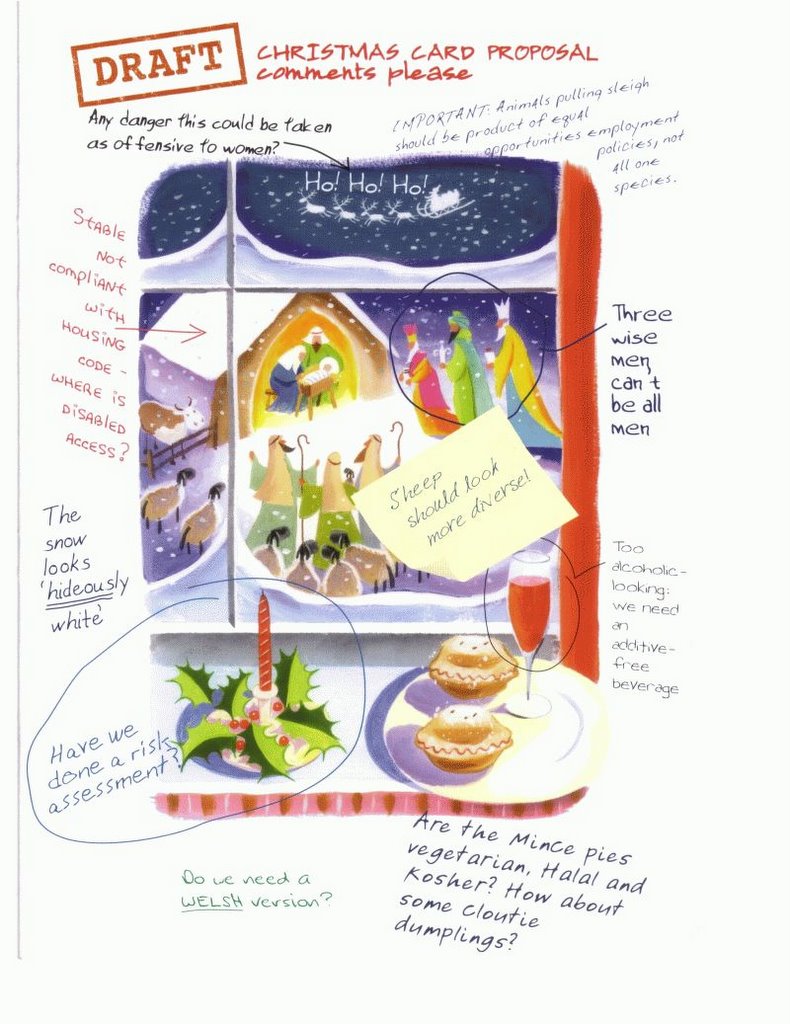
The meaning of Christmas

Banning Christmas trees in court houses -the cancerous political correctness and other nonsense prevelant today - misses the point of what Christmas really means


winnipegsun.com - Editorial - The meaning of Christmas: "The true meaning of Christmas lies in marking and celebrating the birth of the Christ child tomorrow.
  • We do that through prayers and worship, both privately and in church.
  • We do it by sharing the joy of the season with family and friends.
  • By comforting the afflicted and, if we can afford it, donating to worthy charities such as the Salvation Army.
  • That said, there's nothing wrong with giving presents to those we love, as long as they are genuine expressions of love and affection intended to make them happy, not put pressure on them to reciprocate. And as long as we can afford to give what we're getting them.
    The problem is that those who regard Christmas as ONLY about gifts, trees and decorations miss the point.

The real way to celebrate Christmas is through our generosity toward others, measured not by the thickness of our wallets, but by the size of our hearts.

Have a Merry Christmas. "

Friday, December 22, 2006

Are you ready to be optimistic

worth reading and applying in 07

The Power of Positive Self-Talk Brian Tracy
Perhaps the most powerful influence on your attitude and personality is what you say to yourself, and believe. It is not what happens to you, but how you respond internally to what happens to you, that determines your thoughts and felling and, ultimately, your actions. By controlling your inner dialogue, or "self-talk," you can begin to assert control over every other dimension of your life. Your self-talk, the words that you use to describe what is happening to you, and to discuss how you feel about external events, determines the quality and tone of your emotional life. When you see things positively and constructively and look for the good in each situation and each person, you have a tendency to remain naturally positive and optimistic. Since the quality of your life is determined by how you feel, moment to moment, one of your most important goals should be to use every psychological technique available to keep yourself thinking about what you want and to keep your mind off of what you don't want, or what you fear.

Arnold Toynbee, the historian, developed what he called the "challenge-response theory" of history. In studying the rise and fall of 20 major world civilizations, Toynbee concluded that each civilization started out as a small group of people - as a village, as a tribe or in the case of the Mongol empire, as just three people who had survived the destruction of their small community. Toynbee concluded that each of these small groups faced external challenges, such as hostile tribes. In order to survive, much less thrive, these small groups had to reorganize themselves to deal positively and constructively with these challenges. By meeting each of these challenges successfully, the village or tribe would grow. Even greater challenges would be triggered as a result. And if this group of people continued to meet each challenge by drawing upon its resources and winning out, it would continue to grow until ultimately it became a nation-state and then a civilization covering a large geographical area.

Toynbee looked at the 21 great civilizations of human history, ending with the American civilization, and concluded that these civilizations began to decline and fall apart when their citizens and leaders lost the will or ability to rise to the inevitable external challenges occasioned by their very size and power.

Toynbee's theory of civilizations can be applicable to our life as well. You are continually faced with challenges and difficulties, with problems and disappointments, with temporary setbacks and defeats. They are an unavoidable and inevitable part of being human. But, as you draw upon your resources to respond effectively to each challenge, you grow and become a stronger and better person. In fact, without those setbacks, you could not have learned what you needed to know and developed the qualities of your character to where they are today. Much of your ability to succeed comes from the way you deal with life. One of the characteristics of superior men and women is that they recognize the inevitability of temporary disappointments and defeats, and they accept them as a normal and natural part of life. They do everything possible to avoid problems, but when problems come, superior people learn from them, rise above the, and continue onward in the direction of their dreams.

Dr. Martin Seligman of the University of Pennsylvania has written a fascinating book based on his 25 years of research into this subject. It's titled Learned Optimism. In this book, Dr. Seligman explains the basic response patterns of both positive and negative people. As a result of his many years of work in cognitive therapy, and the use of exhaustive testing, he finds, quite simply, that optimistic people tend to interpret events in such a way that they keep their minds positive and their emotions under control. Optimists develop the habit of talking to themselves in constructive ways. Whenever they experience an adversity, they immediately describe it to themselves in such a way that it loses its ability to trigger negative emotions and feelings of helplessness. Dr. Seligman says that are three basic differences in the reactions of optimists and pessimists. The first difference is that the optimist sees a setback as temporary, while the pessimist sees it as permanent. The optimist sees an unfortunate event, such as an order that falls through or a sales call that fails, as a temporary event, something that is limited in time and that has no real impact on the future. The pessimist, on the other hand, sees negative events as permanent, as part of life and destiny. For example, let's say that the optimistic salesperson makes 10 calls on likely prospects, and every one of those calls is unsuccessful. The optimist simply interprets this as a temporary event and a matter of averages or probabilities. The optimist concludes that, with every temporary failure, he is moving closer to the prospect who will turn into a sale. The optimist dismisses the event and goes on cheerfully to the 11th and 12th prospects. The pessimist sees the same situation differently. The pessimist has a tendency to conclude that 10 unsuccessful sales calls is an indication that the economy is terrible and that there is no market for his product. The pessimist generalizes and begins to see the situation and his career as hopeless. While the optimist just shrugs it off and gets on with the next call, the pessimist becomes discouraged and loses heart and enthusiasm for the hard work of prospecting. The second difference between the optimist and the pessimist is that the optimist sees difficulties as specific, while the pessimist sees them as pervasive. This means that when things go wrong for the optimist, he looks at the event as an isolated incident largely disconnected from other things that are going on in his life. For example, if something you were counting on failed to materialize and you interpreted it to yourself as being an unfortunate event, but something that happens in the course of life and business, you would be reacting like an optimist. The pessimist, on the other hand, sees disappointments as being pervasive. That is, to him they are indications of a problem or shortcoming that pervades every area of life. If a pessimist worked hard to put together a business deal and it collapsed, he would tend to assume that the deal did not work out was because the product or the company or the economy was in poor shape and the whole business was hopeless. The pessimist would tend to feel helpless, unable to make a difference and out of control of his destiny. The third difference between optimists and pessimists is that optimists see events as external, while pessimists interpret events as personal. When things go wrong, the optimist will tend to see the setback as result from external factors over which one has little control. If the optimist is cut off in traffic, for example, instead of getting angry or upset, he will simply downgrade the importance of the event by saying something like, "oh, well, I guess that person is just having a bad day." The pessimist has a tendency to take everything personally. If the pessimist is cut off in traffic, he will react as though the other driver has deliberately acted to upset and frustrate him. The pessimist will become angry and negative and want to strike out and get even. Often, he will honk his horn or yell at the other driver. There is a natural tendency in all of us to react emotionally when our expectations are frustrated in any way. When something we wanted and hoped for fails to materialize, we feel a temporary sense of disappointment and unhappiness. We feel disillusioned. We react as though we have been punched in the "emotional solar plexus." The optimistic person, however, soon moves beyond this disappointment. He responds quickly to the adverse event and interprets it as being temporary, specific and external to himself. The optimist takes full control of his inner dialogue and counters the negative feelings by immediately reframing the event so that it appear positive in some way.

*About the Author: Brian Tracy is a leading authority on personal and business success. As Chairman and CEO of Brian Tracy International, he is the best-selling author of 17 books and over 300 audio and video learning programs.

Tuesday, December 19, 2006

Women shop a lot more from the doctor

In the last Daily Dose, I surely got myself in hot water with at least half my audience by citing some new science that gives credence to the age-old notion that women are bigger chatterboxes — er, I mean more comprehensive communicators — than men are…

Well, now there’s some new data validating another stereotype of women the civilized world over: That they tend to shop a lot.

According to another recent article in the UK Daily Mail (Male?), a survey study of 3,000 British women revealed some staggering factoids about every girl’s favorite pastime. If the research is right, the average UK woman:
Makes 301 shopping trips per year for all purposes combined (1 every 29 hours)
“Window-shops” 51 times annually, for a total of more than 2 full days
Spends a combined total of 4 days per year in the supermarket alone
Devotes 90 shopping excursions specifically to finding shoes, clothes, accessories and toiletries for herself
Expends more than one full waking day (18 hours) shopping ONLY for personal deodorants, shower gels, and razors
Makes 19 total shopping quests per year in search of gifts for friends and family
And perhaps the most astounding finding of all: The average UK woman will spend MORE THAN 8 YEARS OF HER LIFE shopping!

Now, before you go and assume that I’m being judgmental or ridiculing of the fairer sex, I want you to think about this: What would the existence of most of the men in these women’s lives be like if they DIDN’T spend so much time in search of the ultimate bargains, tastiest food, and most perfect fashion accessories?

Keep reading…

What would men’s lives be like if their women weren’t borderline shop-a-holics?

I’ll tell you what they’d be like: Dull, boring, colorless, lifeless, curtain-less, TV-dinner-eating, ratty-old-clothes-wearing, greeting card-less, newspaper gift-wrapped, candle-less, smelly-bathroom-ed, unscented-soaped, plain-toweled, holiday-decoration-less, dirt-yarded, ugly-housed, sexless, romance-less, and vacation-less…

Not to mention damn near without a moment’s peace — since their women would always be home instead of out shopping.

I’m serious here, folks. Men can take care of themselves, but not well. They’re hard-wired to think only of the essentials. The big picture. Just about all of the details that make life truly worth living come to us from our women. A lot of men I’ve known bitch about the credit card bills and all the stuff their ladies buy — but they’re failing to consider what those dollars are REALLY buying…

Time to themselves and happiness for their ladies (which equals happiness for them).

What they don’t realize is that this is one of the truly great differences in the sexes that men should appreciate above all other things. Women’s drive to acquire beautiful things, stockpile provisions, and keep themselves (and you) looking as pretty as possible should be nurtured at all costs.

Especially now, during the holidays. So cut loose the plastic, boys, and give your girls the gift they really want this Christmas: A first-class shopping trip (or 10 of them)…

I promise the benefits will come back to you far more than most of the money you could spend on yourself or your own hobbies.

Hopefully not offending about the realities of spending,

William Campbell Douglass II, M.D.

P.S. Lest you think I’m a raving sexist, I’d be willing to bet this: If ever there were a study conducted about the average man’s absorption of sports on TV, I’ll bet it would give the girls’ shopping time a run for its money…

Monday, December 18, 2006

Women talk more -a medical opinion

Women’s lip: A fact of life

I’m going to get in trouble for this one, I just know it. But don’t shoot the messenger…

We spend a lot of time in American society denying or minimizing the differences between the sexes. And as un-PC as it is to say, this is a purely political ploy designed to erase men’s natural advantages in some professional fields — like where physical strength, spatial judgments, or mathematical calculation is required.

Studies NOT at the mercy of the political winds have borne out time and again that men have certain advantages in these areas. Sorry, but it’s true.

Not that women don’t have some major edges in other areas — they do. Look at publishing, writing, editing and journalism fields. The girls not only compete in these arenas, but often dominate them. Same for teaching, nursing, social work and a lot of other careers.

The bottom line is that in this modern political climate, women are allowed to exploit their advantages over men whenever they can — but men aren’t allowed to do the same over women. And if they inadvertently do, they have to be ashamed of it and hide their masculinity every day. It’s a major double standard, and it’d be funny if it weren’t so screwy. But I digress…

Today’s column is about a major difference between men and women that PC political forces try to deny or sweep under the carpet: The fact that women TALK MORE THAN MEN. For some odd reason, this assertion has been raising ladies’ hackles for years. It’s almost as though if this were proved true it would somehow diminish women’s stature in society or something.

Must be a chick thing, I don’t know.

But regardless of how anyone FEELS about it, the fact is that — just as most men have suspected since the dawn of language — women chatter (sorry, vocalize) around 3 times as much as men do. And yet another body of research has proven it.

According to a recent UK Daily Mail article, a new book titled The Female Mind — written by a University of California affiliated, self-labeled feminist named Dr. Luan Brizendine — reveals that the average woman gives voice to around 20,000 words per day, compared to just 7,000 or so from the typical man. Keep reading…

The reasons women talk more than men, Brizendine claims, begin in the womb.

According to this daring doctor, this disparity in expressiveness is the result of actual physiological and hormonal differences in the way men’s and women’s brains develop — not from man-centric societal influences (as most revisionist PC types would maintain).

See? We ARE different! Deal with it, feminists…

As if this isn’t politically incorrect enough, she also maintains that women actually get a kind of heroin-like brain-chemical “buzz” from hearing their own voices! Kind of puts a new twist on things when men say that their women are arguing just to hear themselves talk, doesn’t it? (I’m going to get it for that crack, I know). The news isn’t all unflattering for the ladies, though. Brizendine redeems herself with her militant feminist readers by suggesting that the same brain chemistry differences that make men and women talk at such differing rates also enable men to become “deaf” to their women’s protestations…

Small consolation for the girls, I realize. But I’m in the truth biz, not the “fuzzy lies” one.

And since I’m already in hot water with the fairer sex today — I might as well go all the way with it tomorrow. Stay tuned…

Talking too much (for my own good) about who’s talking too much,

William Campbell Douglass II, M.D.