Monday, December 25, 2006

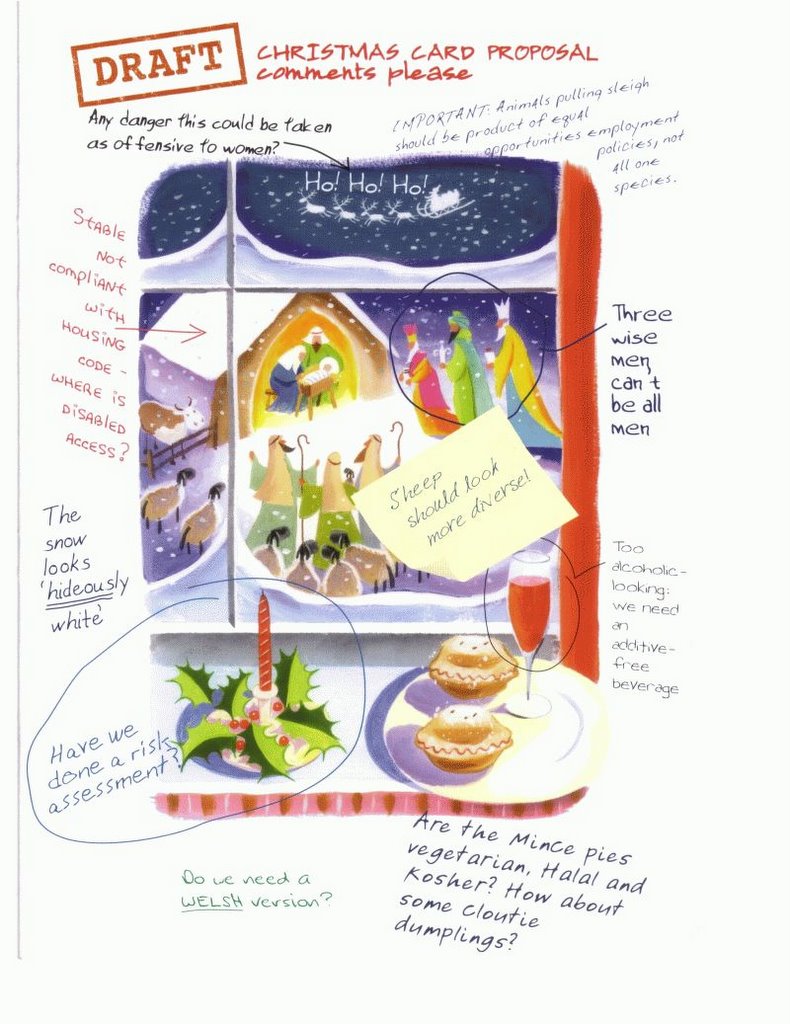
The meaning of Christmas

Banning Christmas trees in court houses -the cancerous political correctness and other nonsense prevelant today - misses the point of what Christmas really means


winnipegsun.com - Editorial - The meaning of Christmas: "The true meaning of Christmas lies in marking and celebrating the birth of the Christ child tomorrow.
  • We do that through prayers and worship, both privately and in church.
  • We do it by sharing the joy of the season with family and friends.
  • By comforting the afflicted and, if we can afford it, donating to worthy charities such as the Salvation Army.
  • That said, there's nothing wrong with giving presents to those we love, as long as they are genuine expressions of love and affection intended to make them happy, not put pressure on them to reciprocate. And as long as we can afford to give what we're getting them.
    The problem is that those who regard Christmas as ONLY about gifts, trees and decorations miss the point.

The real way to celebrate Christmas is through our generosity toward others, measured not by the thickness of our wallets, but by the size of our hearts.

Have a Merry Christmas. "

Friday, December 22, 2006

Are you ready to be optimistic

worth reading and applying in 07

The Power of Positive Self-Talk Brian Tracy
Perhaps the most powerful influence on your attitude and personality is what you say to yourself, and believe. It is not what happens to you, but how you respond internally to what happens to you, that determines your thoughts and felling and, ultimately, your actions. By controlling your inner dialogue, or "self-talk," you can begin to assert control over every other dimension of your life. Your self-talk, the words that you use to describe what is happening to you, and to discuss how you feel about external events, determines the quality and tone of your emotional life. When you see things positively and constructively and look for the good in each situation and each person, you have a tendency to remain naturally positive and optimistic. Since the quality of your life is determined by how you feel, moment to moment, one of your most important goals should be to use every psychological technique available to keep yourself thinking about what you want and to keep your mind off of what you don't want, or what you fear.

Arnold Toynbee, the historian, developed what he called the "challenge-response theory" of history. In studying the rise and fall of 20 major world civilizations, Toynbee concluded that each civilization started out as a small group of people - as a village, as a tribe or in the case of the Mongol empire, as just three people who had survived the destruction of their small community. Toynbee concluded that each of these small groups faced external challenges, such as hostile tribes. In order to survive, much less thrive, these small groups had to reorganize themselves to deal positively and constructively with these challenges. By meeting each of these challenges successfully, the village or tribe would grow. Even greater challenges would be triggered as a result. And if this group of people continued to meet each challenge by drawing upon its resources and winning out, it would continue to grow until ultimately it became a nation-state and then a civilization covering a large geographical area.

Toynbee looked at the 21 great civilizations of human history, ending with the American civilization, and concluded that these civilizations began to decline and fall apart when their citizens and leaders lost the will or ability to rise to the inevitable external challenges occasioned by their very size and power.

Toynbee's theory of civilizations can be applicable to our life as well. You are continually faced with challenges and difficulties, with problems and disappointments, with temporary setbacks and defeats. They are an unavoidable and inevitable part of being human. But, as you draw upon your resources to respond effectively to each challenge, you grow and become a stronger and better person. In fact, without those setbacks, you could not have learned what you needed to know and developed the qualities of your character to where they are today. Much of your ability to succeed comes from the way you deal with life. One of the characteristics of superior men and women is that they recognize the inevitability of temporary disappointments and defeats, and they accept them as a normal and natural part of life. They do everything possible to avoid problems, but when problems come, superior people learn from them, rise above the, and continue onward in the direction of their dreams.

Dr. Martin Seligman of the University of Pennsylvania has written a fascinating book based on his 25 years of research into this subject. It's titled Learned Optimism. In this book, Dr. Seligman explains the basic response patterns of both positive and negative people. As a result of his many years of work in cognitive therapy, and the use of exhaustive testing, he finds, quite simply, that optimistic people tend to interpret events in such a way that they keep their minds positive and their emotions under control. Optimists develop the habit of talking to themselves in constructive ways. Whenever they experience an adversity, they immediately describe it to themselves in such a way that it loses its ability to trigger negative emotions and feelings of helplessness. Dr. Seligman says that are three basic differences in the reactions of optimists and pessimists. The first difference is that the optimist sees a setback as temporary, while the pessimist sees it as permanent. The optimist sees an unfortunate event, such as an order that falls through or a sales call that fails, as a temporary event, something that is limited in time and that has no real impact on the future. The pessimist, on the other hand, sees negative events as permanent, as part of life and destiny. For example, let's say that the optimistic salesperson makes 10 calls on likely prospects, and every one of those calls is unsuccessful. The optimist simply interprets this as a temporary event and a matter of averages or probabilities. The optimist concludes that, with every temporary failure, he is moving closer to the prospect who will turn into a sale. The optimist dismisses the event and goes on cheerfully to the 11th and 12th prospects. The pessimist sees the same situation differently. The pessimist has a tendency to conclude that 10 unsuccessful sales calls is an indication that the economy is terrible and that there is no market for his product. The pessimist generalizes and begins to see the situation and his career as hopeless. While the optimist just shrugs it off and gets on with the next call, the pessimist becomes discouraged and loses heart and enthusiasm for the hard work of prospecting. The second difference between the optimist and the pessimist is that the optimist sees difficulties as specific, while the pessimist sees them as pervasive. This means that when things go wrong for the optimist, he looks at the event as an isolated incident largely disconnected from other things that are going on in his life. For example, if something you were counting on failed to materialize and you interpreted it to yourself as being an unfortunate event, but something that happens in the course of life and business, you would be reacting like an optimist. The pessimist, on the other hand, sees disappointments as being pervasive. That is, to him they are indications of a problem or shortcoming that pervades every area of life. If a pessimist worked hard to put together a business deal and it collapsed, he would tend to assume that the deal did not work out was because the product or the company or the economy was in poor shape and the whole business was hopeless. The pessimist would tend to feel helpless, unable to make a difference and out of control of his destiny. The third difference between optimists and pessimists is that optimists see events as external, while pessimists interpret events as personal. When things go wrong, the optimist will tend to see the setback as result from external factors over which one has little control. If the optimist is cut off in traffic, for example, instead of getting angry or upset, he will simply downgrade the importance of the event by saying something like, "oh, well, I guess that person is just having a bad day." The pessimist has a tendency to take everything personally. If the pessimist is cut off in traffic, he will react as though the other driver has deliberately acted to upset and frustrate him. The pessimist will become angry and negative and want to strike out and get even. Often, he will honk his horn or yell at the other driver. There is a natural tendency in all of us to react emotionally when our expectations are frustrated in any way. When something we wanted and hoped for fails to materialize, we feel a temporary sense of disappointment and unhappiness. We feel disillusioned. We react as though we have been punched in the "emotional solar plexus." The optimistic person, however, soon moves beyond this disappointment. He responds quickly to the adverse event and interprets it as being temporary, specific and external to himself. The optimist takes full control of his inner dialogue and counters the negative feelings by immediately reframing the event so that it appear positive in some way.

*About the Author: Brian Tracy is a leading authority on personal and business success. As Chairman and CEO of Brian Tracy International, he is the best-selling author of 17 books and over 300 audio and video learning programs.

Tuesday, December 19, 2006

Women shop a lot more from the doctor

In the last Daily Dose, I surely got myself in hot water with at least half my audience by citing some new science that gives credence to the age-old notion that women are bigger chatterboxes — er, I mean more comprehensive communicators — than men are…

Well, now there’s some new data validating another stereotype of women the civilized world over: That they tend to shop a lot.

According to another recent article in the UK Daily Mail (Male?), a survey study of 3,000 British women revealed some staggering factoids about every girl’s favorite pastime. If the research is right, the average UK woman:
Makes 301 shopping trips per year for all purposes combined (1 every 29 hours)
“Window-shops” 51 times annually, for a total of more than 2 full days
Spends a combined total of 4 days per year in the supermarket alone
Devotes 90 shopping excursions specifically to finding shoes, clothes, accessories and toiletries for herself
Expends more than one full waking day (18 hours) shopping ONLY for personal deodorants, shower gels, and razors
Makes 19 total shopping quests per year in search of gifts for friends and family
And perhaps the most astounding finding of all: The average UK woman will spend MORE THAN 8 YEARS OF HER LIFE shopping!

Now, before you go and assume that I’m being judgmental or ridiculing of the fairer sex, I want you to think about this: What would the existence of most of the men in these women’s lives be like if they DIDN’T spend so much time in search of the ultimate bargains, tastiest food, and most perfect fashion accessories?

Keep reading…

What would men’s lives be like if their women weren’t borderline shop-a-holics?

I’ll tell you what they’d be like: Dull, boring, colorless, lifeless, curtain-less, TV-dinner-eating, ratty-old-clothes-wearing, greeting card-less, newspaper gift-wrapped, candle-less, smelly-bathroom-ed, unscented-soaped, plain-toweled, holiday-decoration-less, dirt-yarded, ugly-housed, sexless, romance-less, and vacation-less…

Not to mention damn near without a moment’s peace — since their women would always be home instead of out shopping.

I’m serious here, folks. Men can take care of themselves, but not well. They’re hard-wired to think only of the essentials. The big picture. Just about all of the details that make life truly worth living come to us from our women. A lot of men I’ve known bitch about the credit card bills and all the stuff their ladies buy — but they’re failing to consider what those dollars are REALLY buying…

Time to themselves and happiness for their ladies (which equals happiness for them).

What they don’t realize is that this is one of the truly great differences in the sexes that men should appreciate above all other things. Women’s drive to acquire beautiful things, stockpile provisions, and keep themselves (and you) looking as pretty as possible should be nurtured at all costs.

Especially now, during the holidays. So cut loose the plastic, boys, and give your girls the gift they really want this Christmas: A first-class shopping trip (or 10 of them)…

I promise the benefits will come back to you far more than most of the money you could spend on yourself or your own hobbies.

Hopefully not offending about the realities of spending,

William Campbell Douglass II, M.D.

P.S. Lest you think I’m a raving sexist, I’d be willing to bet this: If ever there were a study conducted about the average man’s absorption of sports on TV, I’ll bet it would give the girls’ shopping time a run for its money…
Monday, December 18, 2006

Women talk more -a medical opinion

Women’s lip: A fact of life

I’m going to get in trouble for this one, I just know it. But don’t shoot the messenger…

We spend a lot of time in American society denying or minimizing the differences between the sexes. And as un-PC as it is to say, this is a purely political ploy designed to erase men’s natural advantages in some professional fields — like where physical strength, spatial judgments, or mathematical calculation is required.

Studies NOT at the mercy of the political winds have borne out time and again that men have certain advantages in these areas. Sorry, but it’s true.

Not that women don’t have some major edges in other areas — they do. Look at publishing, writing, editing and journalism fields. The girls not only compete in these arenas, but often dominate them. Same for teaching, nursing, social work and a lot of other careers.

The bottom line is that in this modern political climate, women are allowed to exploit their advantages over men whenever they can — but men aren’t allowed to do the same over women. And if they inadvertently do, they have to be ashamed of it and hide their masculinity every day. It’s a major double standard, and it’d be funny if it weren’t so screwy. But I digress…

Today’s column is about a major difference between men and women that PC political forces try to deny or sweep under the carpet: The fact that women TALK MORE THAN MEN. For some odd reason, this assertion has been raising ladies’ hackles for years. It’s almost as though if this were proved true it would somehow diminish women’s stature in society or something.

Must be a chick thing, I don’t know.

But regardless of how anyone FEELS about it, the fact is that — just as most men have suspected since the dawn of language — women chatter (sorry, vocalize) around 3 times as much as men do. And yet another body of research has proven it.

According to a recent UK Daily Mail article, a new book titled The Female Mind — written by a University of California affiliated, self-labeled feminist named Dr. Luan Brizendine — reveals that the average woman gives voice to around 20,000 words per day, compared to just 7,000 or so from the typical man. Keep reading…

The reasons women talk more than men, Brizendine claims, begin in the womb.

According to this daring doctor, this disparity in expressiveness is the result of actual physiological and hormonal differences in the way men’s and women’s brains develop — not from man-centric societal influences (as most revisionist PC types would maintain).

See? We ARE different! Deal with it, feminists…

As if this isn’t politically incorrect enough, she also maintains that women actually get a kind of heroin-like brain-chemical “buzz” from hearing their own voices! Kind of puts a new twist on things when men say that their women are arguing just to hear themselves talk, doesn’t it? (I’m going to get it for that crack, I know). The news isn’t all unflattering for the ladies, though. Brizendine redeems herself with her militant feminist readers by suggesting that the same brain chemistry differences that make men and women talk at such differing rates also enable men to become “deaf” to their women’s protestations…

Small consolation for the girls, I realize. But I’m in the truth biz, not the “fuzzy lies” one.

And since I’m already in hot water with the fairer sex today — I might as well go all the way with it tomorrow. Stay tuned…

Talking too much (for my own good) about who’s talking too much,

William Campbell Douglass II, M.D.

Wednesday, August 09, 2006

House warming

Summer does not have to be boring . Want a challenge - try a retrofit and house makeover -chuckle Posted by Picasa

Thursday, June 29, 2006

Whining Ways

MSN Hotmail - Message: "Whining Ways
Whining is one of the childhood behaviors most disliked by adults -- it's plain annoying, grating and unproductive. Meanwhile, it's also a behavior that many adults still engage in -- a lot. In fact, according to Lauren Zander, Principal of The Handel Group, a consultancy that helps corporations to flourish by helping individuals to reach their true potetntial within the organization and Meredith Haberfeld, CEO of Handel Group subsidiary Personal-Evolution www.personal-evolution.com, most adults have carefully disguised their whining by removing the irritating intonation from their voice or simply by doing most of their whining in their own heads, to a spouse or to a best friend. But that doesn't make whining any less toxic.
No matter the form, whining is highly unproductive for the simple reason that it takes the place of proactively taking action to change things. As such, it becomes a major stumbling block standing in the way of healthier habits, a richer and more fulfilling life and better, more loving relationships. Once you're aware of how prevalent whining is, you'll understand why I wanted to share Lauren and Meredith's philosophy on how to rid ourselves and our world of whining.
THE WHYS OF WHINING
People whine when they feel powerless -- or at least when they think they're powerless. Children form the habit of whining because they quickly learn it can get them something they want that they can't (or choose not to) get for themselves. Say a chil"

Monday, April 24, 2006

Foreverhealthy - Articles

Foreverhealthy - Articles: "THE POWER OF �LIVING� WATER
by Wayne Gendel May 2003
LONGEVITY Is Associated with Drinking Mineralized Oxygen Rich Natural Pure �Living� Water!
But!
Premature Aging Comes From Drinking Distilled &/Or Non Filtered & Polluted Dead Waters!
Like a perfectly ripe piece of fruit, a good glass of water is pure, clean and alive! It is refreshing and satisfying. Drinking water is 1 of the 3 most important things we do every day! The other two are eating and sleeping! Interesting how most of us spend very little time understanding and learning about water! Even less than healthy eating or sleeping, and not that most have much knowledge in those areas! Hopefully one day schools and more people will understand the importance and power of water in its effects on our health. Most people will take weeks researching stereos or cell phones! And yet water effects our health more than virtually anything else we do on a daily basis!
Let�s find out how to drink the water of the longest lived healthiest people on the planet!
First let�s understand what NOT to drink! PLEASE do NOT drink plain Distilled, Reverse Osmosis (R.O) or unfiltered tap or most spring waters on a daily basis! They are DEAD waters! Of course the occasional glass is fine. I hope you agree that drinking unfiltered tap water could be hazardous to your health because of parasites, chlorine, fluoride, dioxins, heavy metals and a host of dangerous chemicals! Would you let a baby drink tap water? There are now over 75,000 chemicals on record produced in the world! Many can and do get in the water supply. Most of these chemicals can cause bladder and kidney cancers as well as nervous system damage. (11)
Many mimic our estrogen and are commonly referred to as xeno-estrogens. Excess estrogen is associated with "

Wednesday, April 12, 2006

Tanning high?

Tanning is a drug.

Well...sort of. According to recent research, people who tan themselves more than twice each week may be addicted to endorphins created in skin cells exposed to sunlight. Endorphins are opioid compounds that provide a mental boost and a feeling of wellbeing. Heroin and morphine are opioids, and just like these drugs, tanning can be addicting.

This theory was put to a test in a recent trial conducted by researchers at Wake Forest University Baptist Medical Center. Sixteen subjects were recruited: eight infrequent tanners, and eight frequent tanners. "Frequent" was defined as eight to fifteen tanning sessions per month.

Each subject was given 5 mg of naltrexone; a drug that blocks the effects of opioids by competing for opioid receptors in the brain. Naltrexone is used to treat opioid dependence and alcoholism.

Researchers steadily upped the naltrexone dosage until all subjects were receiving 15 mg. At that point, four of the frequent tanners displayed typical withdrawal symptoms such as jitteriness and nausea. Two of the four had to drop out of the study. Presumably they stripped to their skivvies and made a beeline for the beach.

None of the infrequent tanners had withdrawal symptoms.

On the upside, it's a good bet that all of these subjects have impressive vitamin D levels. The downside, of course, is a sharply increased risk of skin cancer. Richard Wagner, Jr., M.D. (who was not involved in the Wake Forest research), told WebMD Medical News that frequent tanning is a type of substance abuse so powerful that some skin cancer patients can't stop tanning, even though they're aware of the damage they're doing to themselves.

Most tanners, however, are probably not aware that they may be skin cancer patients in the making. As part of his research, Dr. Wagner took a trip to a beach where he used addiction questionnaires to survey a number of tanners at random. He told WebMD that about half the respondents had tanning habits that qualified as a substance-related disorder.

Sunday, April 09, 2006

Running on high octane or burning out big time?

Running on high octane or burning out big time?: "GETTING THE LEAST FROM YOUR STAFF
- Impose unreasonable demands.
- Refuse to give employees reasonable discretion over work.
- Fail to credit or acknowledge contributions and achievements.
- Create a treadmill -- too much to do, all at once, all the time.
- Create perpetual doubt, leaving workers unsure about future.
- Allow office politics to disrupt positive behaviour.
- Tolerate or foster unclear direction and job ambiguity.
- Reject, out of hand, employee workload concerns.
- Remember -- performance reviews (even positive ones) don't establish workers' role in the company's future. -- Global Business and Economic Roundtable on Addiction and Mental Health"

Wednesday, March 22, 2006

Men are Like ....

Men are like....

1. Men are like .....Laxatives .... They irritate the shit out of you.

2. Men are like ...... Bananas .... The older they get, the less firm they are.

3. Men are like ..... Weather ..... Nothing can be done to change them.

4. Men are like ........ Blenders ..... You need One, but you're not quite sure why.

5. Men are like ....... Chocolate Bars .... Sweet, smooth, & they usually head right for your hips.

6.Men are like ....... Commercials ..... You can't believe a word they say.

7. Men are like ........ Department Stores ..... Their clothes are always 1/2 off.

8. Men are like ........ Government Bonds ..... They take soooooooo long to mature.

9. Men are like ....... Mascara ...... They usually run at the first sign of emotion.

10. Men are like .... Popcorn . ...They satisfy you, but only for a little while.

11. Men are like ..... Snowstorms ...... You never know when they're coming, how many inches you'll get or how long it will last.

12. Men are like ..... Lava Lamps ..... Fun to look at, but not very bright.

13. Men are like ..... Parking Spots .....All the good ones are taken, the rest are handicapped.

Thursday, March 16, 2006

Make you luck

Yahoo! Mail - respondfeedbacknow@yahoo.ca: "Clever Ways to Create Your Own Luck
Susan RoAne
y first book, How to Work a Room, was rejected by more than 20 publishers. Then a friend suggested that I attend the American Library Association's convention. I had the flu that day and didn't want to go. I went anyway -- and wound up meeting the publisher who said yes to my book. It went on to sell well over a million copies.

Was I lucky? Yes -- but only because I took an active step toward good fortune, rather than waiting for fortune to find me.
Lucky people always are on the lookout for 'you never know' moments, chance encounters that open doors to all sorts of possibilities. Here's how to find and maximize those opportunities...
Talk to strangers. It's the people you don't know who bring new opportunities to your doorstep. Example: A couple went to the opera and started a conversation with the couple seated next to them. During intermission, the second couple decided to leave early -- and asked the first couple if they would like to have their tickets to the postopera gala ball. It never would have happened without the chitchat. Helpful...
Focus on what you have in common. When you're in the same place with a stranger -- a charity fundraiser, for example, or your child's school -- you have something in common just by being there. It gives you something to talk about.
Wear something that invites people to talk to you. Madeleine Albright, the former US ambassador to the United Nations, often wore a large brooch because it was a conversation starter. Men can wear ties that reflect their interests, such as one from an art museum or a boater's club.
Smile and say hello. Make eye contact. Show that you're approachable, even if you'"

Erasing tatoo regret - with lazers

"Erasing tattoo regret"

Clinics remove tatoos with lazer surgery - some costs covered by Health care. Interesting opportunity -minor surgery

Wednesday, March 01, 2006

No more!

No more!: "No more!
For our own good (and your amusement), we see what happens when we give up our favourite indulgences"

Saturday, February 11, 2006

Lusty Cdns. dialing up romantic heat

Lusty Cdns. dialing up romantic heat: "Lusty Cdns. dialing up romantic heat
Survey says when it comes to sex, most Canadians are phoning it in"

Wednesday, December 07, 2005

Getting Noticed

Getting Noticed: "Getting Noticed
Doctors, accountants, and other professionals need to market their businesses, too. Here's what works

Jordan Lipton, 40, and Elizabeth Perry, 39, loved being doctors. They had 20 years of hospital practice between them, but they wanted to spend more time with patients than the hospital-mandated seven minutes. They even dreamed of making house calls. "

Creativity tied to sexual "success"

- Artists may indeed have a more active love life than most of us -- and part of the reason may be their tendency toward a certain schizophrenia-linked personality trait, a study suggests.

In a survey of 425 British adults, researchers found that serious poets and visual artists generally had more sexual partners than those who were either not artistic or only dabbled in the arts.
Further analysis showed that one personality dimension -- a tendency toward "unusual" thoughts and perceptions -- was related to both creativity and sexual success.
That tendency is also seen in people with schizophrenia. And the findings, according to the study authors, may help explain why schizophrenia -- a mental disorder that often runs in families -- has not been extinguished from the gene pool.

Full storyhttp://news.yahoo.com/s/nm/20051207/hl_nm/creativity_tied_sexual_success_dc

Saturday, December 03, 2005

winnipegsun.com - Canada News - Size doesn't matter

winnipegsun.com - Canada News - Size doesn't matter

A 22-year-old student, who cannot be identified, claimed his penis is too big to insert into an average vagina without special preparation or it would cause bleeding and scarring.


A urologist brought to court a plastic model that depicted the size of the member at a semi-relaxed state, which measured 8 1/2 inches long and 6 1/2 inches in girth.

Court heard the male and female were close friends and often slept together platonically, but one night he forced her to have sex after a night of partying together at a Barrie pub.

In the end, the judge accepted that the accused is "unusually large" but she noted the female was never questioned on the witness stand about it, nor did she report any physical pain, discomfort or injury.

ouch -he was found quilty